

Custom tracksuit manufacturing from 50 pieces
This page is written for founders putting a tracksuit into production, not for anyone ordering a single printed set. A NO FUGAZI tracksuit is cut and sewn from scratch: your fit block, your fabric weight, your cuffs, your trims, your labels. As seen on King Promise.
Send whatever you have - a sketch, a moodboard, reference photos or a tracksuit you already own - and we will quote against it. Price depends entirely on spec, so there are no prices on this page. We are most competitive at higher volumes.
Tracksuit manufacturing
Custom tracksuit specification
The facts a founder needs before commissioning a tracksuit production run with NO FUGAZI.
- Minimum order
- 50 piecesSpecific designs, colours and fabrics can affect the MOQ, so send your spec and we will confirm it for your set.
- What we make
- Cut-and-sew tracksuitsHooded or crewneck tops, zip or pullover, with matching bottoms. Made to order - we hold no stock garments.
- Tech pack
- Not requiredA sketch, a moodboard, reference photos or an existing tracksuit is enough. We handle pattern development and fit development in house.
- Sample lead time
- 2-3 weeks
- Bulk lead time
- 3-8 weeks after sample approvalPlus shipping to your destination.
- Colour
- Pantone matched across the setCustom-dyed or sourced to your Pantone reference, with top and bottom checked together against it before cutting.
- Fabric
- Sourced or produced per orderSpecified to the weight and handfeel you want. Send a garment that feels right and we can work from it. Yarn is from OEKO-TEX certified suppliers. Acrylic wool knitted to your gauge, and faux fur or mohair for trims.
- Shrinkage
- Pre-shrunk, 1–3% residualEvery cloth we cut is low-shrinkage and pre-shrunk before it reaches the cutting table, so a garment that fits at sample stage still fits after it has been washed. Residual movement is 1–3%, which is inside the tolerance a graded size chart already allows for.
- Decoration
- Embroidery, 3D puff, appliqué, chenille, screen print, high-density silicone, DTF, sublimation, vinyl, rhinestone, reflective, piping
- Branding
- Woven and rubber labels, custom cords, tips, eyelets, zip pullers, piping, swing tagsPlus custom fits, so the set is yours rather than a relabelled blank.
- Sampling
- Always before bulkA free sample of each design is included with every committed bulk order. One revision round is free. A standalone sample without a bulk commitment is charged.
- Quality control
- 4 stagesFabric inspection, in-process checks, post-production inspection and a final pre-shipment review.
- Based
- London, UKManaged from London; made at our own dedicated facility. We ship worldwide. Payment is by bank transfer, on terms agreed with your quote.
- Packaging
- Recyclable frosted bags, swing tags, woven labels and custom tissuePolybags are recyclable frosted as standard. Swing tags, tissue and box print are specified with the rest of the trim, not left to the end.
Send a sketch, a moodboard or a tracksuit you already own - all work.
The hard part is making two garments the same colour
Fabric is dyed in batches. Two rolls of the same cloth, dyed to the same recipe on different days, can come off the line fractionally apart in tone. Nobody notices that on a single hoodie. Put the top next to the bottom in daylight and half a shade is the first thing anyone sees.
It gets harder when the top and the bottom are not the same cloth. A brushed-back top and a lighter-weight bottom take dye differently even on the same recipe, because the surface, the pile and the fibre content all change how light comes back off the fabric.
How we control it. Your colour is fixed to a Pantone reference at the start rather than described in words, so "off-white" or "washed black" means one specific thing to everyone handling the order. Fabrics are custom-dyed or sourced to that reference. Both fabrics are matched to the same reference and checked together before cutting - fabric inspection is the first of our four quality control stages, and it happens before a single piece is cut.
You confirm the result yourself on the sample. Lay the top on the bottoms in daylight rather than under a lamp. That is the check we ask every client to make before approving bulk.
What you decide before we cut
Fabric weight
Weight sets the character of the whole set. Lighter cloth drapes and hangs close to the body. Heavier cloth holds its shape, stands away from the frame and reads as the more expensive garment - it is also warmer, slower to dry and costs more to ship.
If you cannot name a weight, send us a tracksuit that feels right and we will work from it.
The fit block
The fit block is the base shape everything is graded from: shoulder drop, body length, sleeve length, and the rise and taper of the bottoms. A boxy shoulder with a dropped seam is a different pattern, not a different size.
Pattern development and fit development are ours to handle. Tell us the silhouette, or send the garment whose fit you want replicated.
Cuffs and Waistbands
Ribbing is where a tracksuit ages fastest. Cuffs and hems that lose their recovery leave the set looking tired after a few washes, and it is the part customers notice first.
Decide the depth of the cuff and hem, how snug you want them, and whether the bottoms take a drawcord, elastic or both. Waistband construction changes the fit more than most founders expect.
Zip or Pullover
A pullover hood is a cleaner canvas for a large front print. A full zip is a different pattern entirely: a placket, zip tape, a facing, and a hood that has to finish neatly at the throat.
Quarter-zips and half-zips sit between the two. Each is a separate style with its own pattern, so say early if you want more than one in the same drop.
Pocket construction
On the top: a kangaroo pouch, welt pockets set into a seam, or nothing at all for an uninterrupted front. On the bottoms: side seam pockets, patch pockets, or a zipped back pocket.
Pockets are structural. A pouch changes how the front panel hangs and a zipped pocket needs reinforcement behind it, so this is a construction decision, not a detail added at the end.
Taping and Piping
A contrast stripe down the leg, piping along a panel seam, taped shoulders, a bound hood opening - these are the details that make a plain tracksuit look designed.
They are also the details that expose poor sewing, because a tape that wanders by a millimetre shows along the whole leg. Every piece is cut, stitched and finished by hand, and taped seams are checked at the in-process stage.
Finishing
Tracksuit finishing, up close
Embroidery, hardware, print placement and the stitching around them, photographed on finished pieces rather than mocked up on a blank.
-

Embroidery
-

Hardware
-

Print
-

Zip through


Threads, trims and hardware are specified per order, not picked off a stock list.
Sizes, colourways and the 50-piece minimum
A tracksuit is two garments, and the run has to cover a size curve as well. The practical questions are how many colourways you want, which sizes you want in each, and how many of each size.
Every extra colourway means another dye batch and another set of fabric to inspect. Every extra style - a zip top alongside a pullover, a straight leg alongside a taper - means another pattern and another setup. That is why the minimum is not a single fixed rule: specific designs, colours and fabrics can affect it. Send us the split you want and we will tell you what works rather than leaving you to guess.
Sizing itself is handled for you. Pattern cutting and size grading are included as standard, so the fit you approve on the sample is the fit that comes out in every size. We quote against your exact spec rather than a published rate card, and we are most competitive at higher volumes.
How a tracksuit order runs
1. Send your spec

WhatsApp is the fastest route
Message us with whatever exists: a sketch, a moodboard, reference photos or a tracksuit you already own. Tell us roughly how many pieces and how many colourways. We come back with a tailored quote, and changes to a quote are always free.
- No tech pack required. If you have one, we quote straight from it
2. Patterns and fit blocks

Two garments, one silhouette
We develop patterns for the top and the bottoms from your measurements or from a garment you send in, then grade them across your size run. Fit replication, pattern cutting and grading are included as standard.
- Top and bottoms are drafted together so the set reads as one piece
3. Fabric, colour and dye lots

Where the set is won or lost
Fabric is sourced or custom-dyed for your order, to the weight and handfeel you specified and matched to your Pantone reference. Tops and bottoms are matched to the same reference and checked together before cutting. Decoration and trims are planned in here rather than bolted on later.
- Fabric inspection is the first of four quality control stages, before anything is cut
4. Sampling and Approval

2-3 Weeks
Your sample tracksuit is made in 2-3 weeks, so you can check the colour match, the fit, the ribbing and the decoration in your hands. A free sample of each design is included with every committed bulk order; a standalone sample without a bulk commitment is charged. One revision round is free, further revisions are chargeable.
- Lay the top on the bottoms in daylight - that is the check that matters
5. Bulk production

3-8 weeks after you approve
Bulk runs at our own dedicated facility with your approved sample as the reference for every piece. Every garment is cut, stitched and finished by hand, with your labels, tags and trims applied to spec.
- Bulk takes 3-8 weeks after sample approval, plus shipping
6. Quality control and shipping

Checked before it leaves
Every order passes four quality control stages: fabric inspection, in-process checks, post-production inspection and a final pre-shipment review. It then ships worldwide - the UK is our priority market, and we also ship to the USA, Canada, Australia and Europe.
- Payment is by bank transfer, on terms agreed with your quote
More ways to finish a tracksuit
Everything below is available on a tracksuit and specified at sampling, not added afterwards. What suits your artwork depends on the artwork, the cloth and where it sits.
Rhinestone and diamante
- How it reads
- Heat-set stones that catch the light and sit proud of the cloth. Physical rather than printed.
- Best for
- Wordmarks, small chest logos and back hits where the point is shine.
- Worth knowing
- It adds weight, and stones shed if a garment is tumble-dried. Care labelling matters more here than with any print.
Sublimation
- How it reads
- Dye taken into the fibre itself, so there is nothing sitting on the surface to crack or peel.
- Best for
- All-over prints, panel fades and anything edge-to-edge on polyester.
- Worth knowing
- Polyester only, and it cannot print white — the base cloth supplies every light tone, so it will not work on a dark ground.
High-density silicone print
- How it reads
- Thick, raised ink with a soft rubbery hand and a hard edge.
- Best for
- Bold logos, numbers and type that should feel deliberate under the hand.
- Worth knowing
- Holds a sharper edge than puff, but costs more per hit and does not suit fine detail.
Vinyl transfer
- How it reads
- Cut film heat-pressed onto the garment. Flat, solid and precise.
- Best for
- Names, numbers, one-offs and short runs where a screen would not pay for itself.
- Worth knowing
- It sits on top of the cloth, so across a large area it reads as a panel and breathes less than a print.
Reflective print and embroidery
- How it reads
- Retroreflective film or thread that stays flat in daylight and lights up under a headlight.
- Best for
- Outerwear, windbreakers and anything worn after dark.
- Worth knowing
- It reads as grey in daylight, so the design has to work as a grey mark first.
Glow in the dark
- How it reads
- Phosphorescent ink or thread — off-white by day, green glow once charged.
- Best for
- Back hits and sleeve details on pieces made for the evening.
- Worth knowing
- It has to be charged by light and the glow fades over minutes, not hours. It is an effect, not a feature.
Appliqué embroidery
- How it reads
- A cut fabric shape laid on and stitched down at the edge. Layered, with real depth.
- Best for
- Large chest and back logos, varsity lettering, anything that would be too dense to fill with thread.
- Worth knowing
- It needs simple shapes. Fine internal detail has to be embroidered on top or dropped.
3D puff embroidery
- How it reads
- Foam laid under the stitch so the mark stands off the surface.
- Best for
- Cap fronts and bold letterforms — the standard for a structured six-panel.
- Worth knowing
- It needs a minimum stitch width and simple outlines. Thin type collapses and small detail closes up.
DTG print
- How it reads
- Ink jetted straight into the cotton. Soft to the hand and photographic in detail.
- Best for
- Full-colour artwork, gradients and photographic prints, especially in small runs.
- Worth knowing
- Cotton only, and it needs a pre-treat. Colour sits brightest on a light ground and it is slower per piece than a screen.
Acid wash
- How it reads
- Bleach carried on pumice, so the colour breaks up in high-contrast mottling.
- Best for
- Hoodies, tees and sweats where the wash is the design.
- Worth knowing
- No two pieces come out identical. That is the look, but it means you cannot approve one piece and expect the run to match it exactly.
Vintage wash
- How it reads
- An even, softened fade — the garment reads as though it has already been worn in.
- Best for
- Pieces meant to look lived-in from the first wear.
- Worth knowing
- The wash takes the print down with the cloth, so artwork is set slightly heavier to survive it.
Enzyme wash
- How it reads
- Enzymes eat back the surface fibres, leaving a softer hand and a cleaner face.
- Best for
- Anything that should feel broken-in without looking faded, and knits prone to pilling.
- Worth knowing
- It removes a little weight, so the finished GSM lands slightly under the greige figure.
Sunfade
- How it reads
- A graduated fade running across the garment, as though it has been left in the sun.
- Best for
- Gradient effects on hoodies, tees and shells.
- Worth knowing
- It is directional, so panel orientation has to be fixed on the pattern before cutting or the gradient breaks at the seams.
Garment dye
- How it reads
- Dyed after it is made up, so the seams and stitching take the colour tonally.
- Best for
- Single-colour pieces with a soft, slightly uneven depth of colour.
- Worth knowing
- Colour varies between dye lots. Order the whole run in one lot, and expect a shade shift on a repeat.
Woven and rubber labels
- How it reads
- Woven damask or satin for the neck, moulded rubber or silicone for a hem tab or chest badge.
- Best for
- Inside neck, hem, sleeve and back-pocket branding.
- Worth knowing
- Rubber needs a simple shape and a minimum thickness. Very fine type in a woven label closes up below about 4mm.
Custom hardware
- How it reads
- Eyelets, drawcord tips, buttons, zip pullers and rivets, finished to your metal and engraved with your mark.
- Best for
- The details a customer touches first, where a stock trim gives a piece away.
- Worth knowing
- Custom hardware carries its own tooling lead time, so it is decided at sampling rather than added later.
Piping and reflective piping
- How it reads
- A corded edge set into the seam, in a contrast colour or a reflective tape.
- Best for
- Side seams, panel lines, sleeve heads and windbreaker sets.
- Worth knowing
- Piping is built into the seam as it is sewn, so it has to be on the pattern before cutting.
Mohair and acrylic wool
- How it reads
- Mohair for a long, open, hairy face; acrylic wool knitted to your gauge for something denser.
- Best for
- Knitted panels, cardigans, collars and trims.
- Worth knowing
- Both are knitted to order rather than cut from stock cloth, which puts them at the longer end of the lead time.
Matching sets are developed as custom cut and sew production, so the jacket and joggers are cut to one block rather than paired from stock.
Custom tracksuit FAQs
As seen in


As seen on
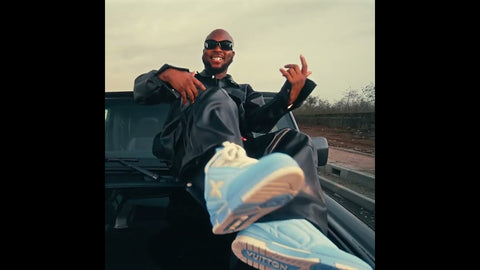 King Promise
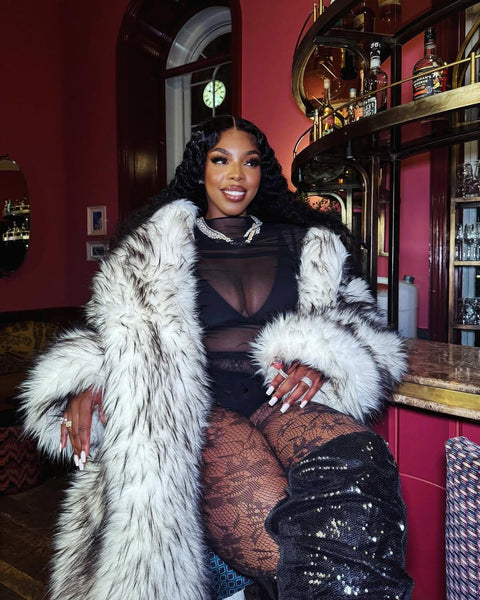 Grace Ajilore
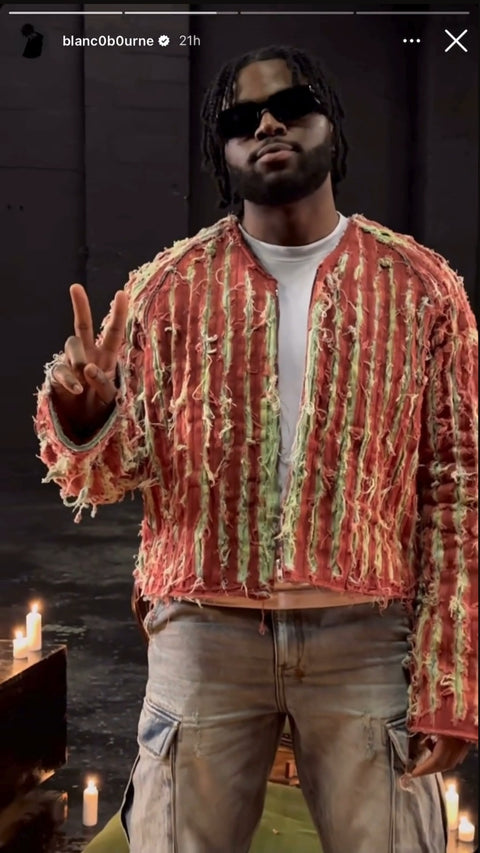 Blanco
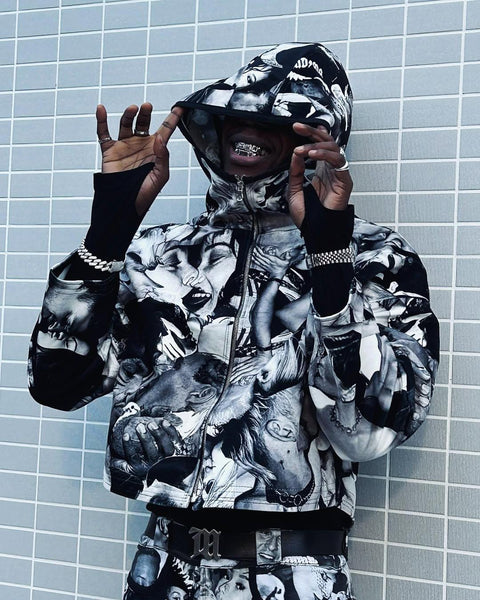 Che Lingo
Spec your tracksuit
Send a sketch, a moodboard or a tracksuit you already own. We will come back with a tailored quote, make your sample first, and start bulk production only once you approve it.
Get a Tracksuit Quote on WhatsApp
